


Page 143 - RECURSOS-fit-2017
P. 143
Olvera                 Paterna de Rivera


                         unque poblada desde el Neolítico, sus
                         vestigios más numerosos datan del perí-
                   Aodo romano, con hallazgos de villas con
         fabulosos suelos de mosaicos, tumbas y monedas de Gades.
         En esta época sus pobladores gozarían ya de las propieda-
         des medicinales de los baños de Fuente Santa y de
         Gigonza, siendo conocida por sus aguas como el Valle de
         los Baños. La presencia musulmana queda también consta-
         tada por hallazgos como un candil almohade (s. XII). Tras
         la Reconquista cristiana pasa a formar parte del Señorío de
         los Ribera que siglos después, en el año 1503, constituye la
         villa como Consejo-Ayuntamiento.
 RECURSOS TURÍSTICOS DE LA PROVINCIA DE CÁDIZ
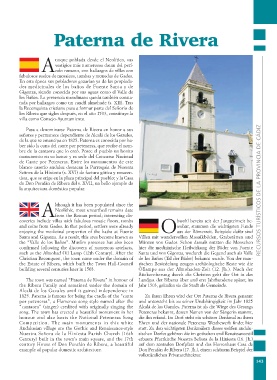
 nown in Roman times as “Hippa” or  Pasa a denominarse Paterna de Rivera en honor a sus
 “Hippo Nova”, this town of Moorish ori-  señores y permanece dependiente de Alcalá de los Gazules,
 Kgin is situated at the foot of a crag crow-  de la que se emancipa en 1825. Paterna es conocida por ha-
 ned by an impressive castle. Declared a Historical Site, the  ber sido la cuna del cante por peteneras, que recibe el nom-
 village centre is an exquisite mixture of Al- Andalus heritage,  bre de la cantaora que lo creó. Posee el pueblo un bonito
 popular architecture and beautiful monuments with manor  monumento en su honor y es sede del Concurso Nacional
 houses with palatial exteriors.  de Cante por Peteneras. Entre los monumentos de este
         blanco caserío andaluz destacan la Parroquia de Nuestra
 The Villa District stands on what was the original centre of  Señora de la Hiniesta (s. XVI) de factura gótica y renacen-
 the ancient town. In the midst of its maze of streets with their  tista, que se erige en la plaza principal del pueblo; y la Casa
 stretches of town walls, you can find the Archpriestal Church  de Don Perafán de Ribera del s. XVII, un bello ejemplo de
 of Nuestra Señora de la Encarnación and the castle, a 12th-cen-  la arquitectura doméstica popular.               RECURSOS TURÍSTICOS DE LA PROVINCIA DE CÁDIZ
 tury Muslim fortress which still boasts walls, towers and the ke-
 ep. On the outskirts of the town, visitors can find the Nuestra
 Señora de los Remedios Shrine and the Caños Santos Convent.  lthough it has been populated since the
                         Neolithic, most unearthed remains date
 Visitors to the “Olvera. La Frontera y los Castillos”  Afrom the Roman period; interesting dis-
 Museum, located in the magnificent Casa de la Cilla building,  coveries include villas with fabulous mosaic floors, tombs  bwohl bereits seit der Jungsteinzeit be-
 can learn about the important role played by the mountain re-  and coins from Gades. In that period, settlers were already  wohnt, stammen die wichtigsten Funde
 gion of Cadiz as the frontier of the Nazarí Kingdom.  enjoying the medicinal properties of the baths at Fuente  Oaus der Römerzeit. Beispiele dafür sind
         Santa and Gigonza. As a result, this area became known as  Villen mit wundervollen Mosaikböden, Grabstätten und
         the “Valle de los Baños”. Muslim presence has also been  Münzen von Gades. Schon damals nutzten die Menschen
 ie römische Hippa oder Hippo Nova mit  confirmed following the discovery of numerous artefacts,  hier die medizinische Heilwirkung der Bäder von Fuente
 a Hippa o Hippo Nova romana de raíces  arabischen Wurzeln liegt am Fuße eines  such as the Almohad Oil Lamp (12th Century). After the  Santa und von Gigonza, wodurch die Gegend auch als Valle
 árabes se sitúa a los pies de un risco coro-  Dvon einer beeindruckenden Burg bekrön-  Christian Reconquest, the town came under the domain of  de los Baños (Tal der Bäder) bekannt wurde. Von der mau-
 Lnado  por  su  impresionante  castillo.  ten Felsens. Im zum historischen Komplex erklärten Ortskern  the Estate of Ribera, which built the Town Hall-Council  rischen Besiedelung zeugen archäologische Reste wie die
 Declarado Conjunto Histórico, su casco urbano presenta una  verschmilzt das Erbe des Al-Andalus, die Volksarchitektur und  building several centuries later in 1503.   Öllampe aus der Almohaden-Zeit (12. Jh.). Nach der
 exquisita mezcla de herencia andalusí, arquitectura popular y  das imposante Denkmalgut mit seinen herrschaftlichen  Rückeroberung durch die Christen geht der Ort in das
 belleza monumental, con sus señoriales fachadas palaciegas.   Palastfassaden.   The town was named “Paterna de Rivera” in honour of  Landgut der Riberas über und erst Jahrhunderte später, im
         the Ribera Family and remained under the domain of  Jahr 1503, gründen sie die Stadt als Gemeinde.
 El Barrio de la Villa se asienta sobre lo que era el primiti-  Das Viertel Barrio de la Villa erhebt sich auf dem urs-  Alcalá de los Gazules until it gained independence in
 vo casco de la ciudad antigua. En su trazado laberíntico y ja-  prünglichen Ortskern der antiken Stadt.Entlang der labyrin-  1825. Paterna is famous for being the cradle of the “cante  Zu ihren Ehren wird der Ort Paterna de Rivera genannt
 lonado de lienzos de muralla se abren paso la Iglesia  thischen von Mauerfassaden gesäumten Straßen finden wir  por peteneras”, a Flamenco song style named after the  und untersteht bis zu seiner Unabhängigkeit im Jahr 1825
 Arciprestal de Nuestra Señora de la Encarnación y el casti-  die Erzpriester-kirche Nuestra Señora de la Encarnación und  “cantaora” (singer) credited with originally singing the  Alcalá de los Gazules. Paterna ist als die Wiege des Gesangs
 llo, fortaleza musulmana del s. XII que aún conserva muros,  den Castillo, eine maurische Festung aus dem 12. Jh., von  song. The town has erected a beautiful monument in her  Peteneras bekannt, dessen Namen von der Sängerin stammt,
 torreones y la Torre del Homenaje. Ya en las afueras encon-  der noch Mauern, Türme und der Huldigungsturm erhalten  honour and also hosts the National Peteneras Song  die ihn erfand. Im Dorf steht ein schönes Denkmal zu ihren
 tramos el Santuario de Nuestra Señora de los Remedios y el  sind. Am Stadtrand befindet sich das Sanktuarium Nuestra  Competition.  The  main  monuments  in  this  white  Ehren und der nationale Peteneras Wettbewerb findet hier
 Convento de Caños Santos.   Señora de los Remedios und das Kloster de Caños Santos.   Andalusian village are the Gothic and Renaissance-style  statt. Zu den wichtigsten Denkmälern dieses weißen andalu-
         Nuestra Señora de la Hiniesta Parish Church (16th   sischen Dorfes gehören die im gotischen und Renaissancestil
 Una visita al Museo “Olvera. La Frontera y los Castillos”,  Eine Besichtigung des Museums „Olvera. La Frontera y  Century) built in the town’s main square, and the 17th  erbaute Pfarrkirche Nuestra Señora de la Hiniesta (16. Jh.)
 ubicado en el magnífico edificio de la Casa de la Cilla, permi-  los Castillos“, im prächtigen Gebäude Casa de la Cilla, vermit-  century House of Don Perafán de Ribera, a beautiful  auf dem zentralen Dorfplatz und das Herrenhaus Casa de
 tirá al visitante conocer el importante papel que jugó la se-  telt dem Besucher einen Einblick in die wichtige Rolle der  example of popular domestic architecture.  Don Perafán de Ribera (17. Jh.), einem schönem Beispiel der
 rranía gaditana como frontera en el reino nazarí.  Sierra de Cádiz als Grenze zum Nasriden-Reich.  volkstümlichen Privatarchitektur.
 142                                                                                                             143

