


Page 127 - RECURSOS-fit-2017
P. 127
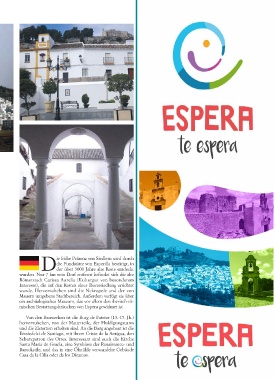
Espera


 RECURSOS TURÍSTICOS DE LA PROVINCIA DE CÁDIZ

 a temprana presencia de
 pobladores queda confir-
 Lmada por el Yacimiento
 de Esperilla con vestigios que se remontan
 más de 3.000 años. Tan sólo a 7 kilómetros
 de la villa se erige la antigua ciudad romana
 de  Carissa  Aurelia  (Bien  de  Interés
 Cultural), que se levanta sobre los restos de
 un anterior asentamiento íbero. En él des-
 tacan la necrópolis y el recinto urbano
 amurallado y cuenta además con un Museo
 Arqueológico, dedicado especialmente al
 Mundo  Funerario  íbero-romano  de
 Espera.                  ie frühe Präsenz von Siedlern wird durch
                          die Fundstätte von Esperilla bestätigt, in
 En su legado monumental sobresale el  Dder über 3000 Jahre alte Reste entdeckt
 Castillo de Fatetar (s. XIII al XV), que  wurden. Nur 7 km vom Dorf entfernt befindet sich die alte
 conserva parte de las murallas, la Torre del Homenaje y los aljibes. Adosada al castillo se encuentra la Ermita de Santiago,  Römerstadt Carissa Aurelia (Kulturgut von besonderem
 que alberga el Cristo de la Antigua, patrón de la localidad. Interesantes resultan también la Iglesia de Santa María de Gracia,  Interesse), die auf den Resten einer Iberersiedlung errichtet
 simbiosis de los estilos renacentista y barroco y la Casa de la Cilla o de los Diezmos, actual molino de aceite.  wurde. Hervorzuheben sind die Nekropole und der von
          Mauern umgebene Stadtbereich. Außerdem verfügt sie über
 he archaeological site at Esperilla attests to the early presence of settlers, with remains which date back over  ein archäologisches Museum, das vor allem den iberisch-rö-
 3,000 years. Just 7 kilometres from the village is the ancient Roman town of Carissa Aurelia (Site of Cultural  mischen Bestattungsbräuchen von Espera gewidmet ist.
 TInterest), which was erected on the remains of an even earlier Iberian settlement. The most important features
 are the necropolis and the walled town,and there is also an Archaeological Museum devoted mainly to the Burial World of Ibero-  Von den Bauwerken ist die Burg de Fatetar (13.-15. Jh.)
 Roman Espera.  hervorzuheben, von der Mauerteile, der Huldigungsturm
          und die Zisternen erhalten sind. An die Burg angebaut ist die
 Amongst its legacy of monuments, particularly worthy of mention is the Fatetar Castle (13th-15th century), which retains  Einsiedelei de Santiago, mit ihrem Cristo de la Antigua, den
 part of its original walls, the keep and the wells. Built against the castle walls is the Santiago Hermitage, which houses the  Schutzpatron des Ortes. Interessant sind auch die Kirche
 Cristo de la Antigua, the image of the town’s patron saint. The Santa María de Gracia Church is also interesting, as a symbio-  Santa María de Gracia, eine Symbiose der Renaissance- und
 sis of Renaissance and Baroque styles, as is the Casa de la Cilla or Casa de los Diezmos, nowadays used as an oil mill.  Barockstile, und das in eine Ölmühle verwandelte Gebäude
          Casa de la Cilla oder de los Diezmos.
 126

