


Page 76 - RECURSOS-fit-2017
P. 76
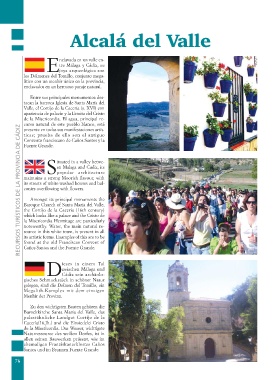
Alcalá del Valle                                                                                                 Algar


                           nclavada en un valle en-                                                                                              ituada entre los parques naturales de la
                           tre Málaga y Cádiz, su                                                                                                Sierra  de  Grazalema  y  Los
                     Ejoya arqueológica son                                                                                                 SAlcornocales, ha sido poblada desde el
           los Dólmenes del Tomillo, conjunto mega-                                                                                Neolítico, como lo demuestra el yacimiento arqueológi-
           lítico con un menhir único en la provincia,                                                                             co de la Cueva de la Dehesilla.
           enclavados en un hermoso paraje natural.
                                                                                                                                      Su herencia artística se halla representada por la
              Entre sus principales monumentos des-                                                                                Iglesia Parroquial de Santa María de Guadalupe y el
           tacan la barroca Iglesia de Santa María del                                                                             Ayuntamiento, ambos neoclásicos, y la Plaza de Toros.
           Valle, el Cortijo de la Cacería (s. XVI) con
           apariencia de palacio y la Ermita del Cristo                                                                               Debido a su privilegiado enclave, son muchas las po-
           de la Misericordia. El agua, principal re-                                                                              sibilidades de ocio con las que se pueden encontrar los
           curso natural de este pueblo blanco, está                                                                               visitantes: desde la caza menor y mayor (que tiene su má-
          RECURSOS TURÍSTICOS DE LA PROVINCIA DE CÁDIZ
           presente en todas sus manifestaciones artís-                                                                            ximo reflejo en la gastronomía de la villa) y el senderis-
           ticas;  prueba  de  ello  son  el  antiguo                                                                              mo en el Tajo del Águila, hasta la pesca en el río
           Convento franciscano de Caños Santos y la                                                                               Majaceite o el piragüismo, la vela o el disfrute de una
           Fuente Grande.                                                                                                          playa en el Embalse de Guadalcacín II.

                                                                                                                                                                                                   wischen den Naturparks Sierra de Grazalema
                          ituated in a valley betwe-                                                                                              ocated between the Natural Parks of              und Los Alcornocales gelegen, war die
                          en Malaga and Cadiz, its                                                                                                the Sierra de Grazalema and Los            ZGegend bereits in der Jungsteinzeit bewohnt,
                     Spopular  architecture                                                                                                 LAlcornocales, this area has been po-   wie die archäologische Fundstätte von La Cueva de la Dehesilla
           maintains a strong Moorish flavour, with                                                                                pulated since Neolithic times, as can be seen at the ar-  bezeugt.
           its streets of white-washed houses and bal-                                                                             chaeological site at Cueva de la Dehesilla.
           conies overflowing with flowers.                                                                                                                                           Das künstlerische Erbe des Ortes bilden die neoklassischen RECURSOS TURÍSTICOS DE LA PROVINCIA DE CÁDIZ
                                                                                                                                      Its artistic heritage is represented by the Parish  Bauten der Pfarrkirche Santa María de Guadalupe und des
              Amongst its principal monuments the                                                                                  Church of Santa María de Guadalupe and the Town  Rathauses sowie die Stierkampfarena.
           Baroque Church of Santa María del Valle,                                                                                Hall, both built in neo-Classical style, and the Bullring.
           the Cortijo de la Cacería (16th century)                                                                                                                                   Aufgrund  seiner  hervorragenden  Lage  werden  dem
           which looks like a palace and the Cristo de                                                                                Given its privileged location, there are many leisure  Besucher hier zahlreiche Freizeitmöglichkeiten geboten, wie
           la Misericordia Hermitage are particularly                                                                              options on offer for visitors to the town, from game-hun-  Nieder- und Hochjagd (was sich auf die Gastronomie des
           noteworthy. Water, the main natural re-                                                                                 ting (as is reflected in the local cuisine) to hill-walking in  Dorfes auswirkt), Wandern im Tajo del Águila, Angelsport im
           source in this white town, is present in all                                                                            the Tajo del Águila to fishing in the River Majaceite, whi-  Fluss  Majaceite,  oder  Kanuund  Segelsport  im  Stausee
           its artistic forms. Examples of this are to be                                                                          le the Guadalcacín II Reservoir offers kayaking, sailing  Guadalcacín II, wo benfalls vom einem künstlichen Strand pro-
           found at the old Franciscan Convent of                                                                                  and beach.                                       fitiert werden kann.
           Caños Santos and the Fuente Grande.


                            ieses  in  einem  Tal
                            zwischen Málaga und
                     DCádiz sein archäolo-
           gisches Schmuckstück in schöner Natur
           gelegen, sind die Dolmen del Tomillo, ein
           Megalith-Komplex mit dem einzigen
           Menhir der Provinz.
              Zu den wichtigsten Bauten gehören die
           Barockkirche Santa María del Valle, das
           palastähnliche Landgut Cortijo de la
           Cacería(16.Jh.) und die Einsiedelei Cristo
           de la Misericordia. Das Wasser, wichtigste
           Naturressource des weißen Dorfes, ist in
           allen seinen Bauwerken präsent, wie im
           ehemaligen Franziskanerkloster Caños
           Santos und im Brunnen Fuente Grande.

        76                                                                                                                                                                                                                                77

