


Page 72 - Recursos Turísticos Verano 2017
P. 72
Cádiz


                           he “Tacita del Plata” is considered the ol-
                           dest city in the Western World. It was
                      Tfounded  (in  1100  B.C.)  by  the
            Phoenicians, a seafaring people who turned Gadir into an
            important trading colony where the Carthaginians, the
            Romans, the Visigoths  and the Muslims would all subse-
            quently settle. An open, cosmopolitan city, it sport was cho-
            sen by Columbus as the point of departure for his second
            voyage to the New World. The city would then become, af-
            ter the decline of Seville, the port to The Indies, drawing
            the flow of trade with the American Continent. This frantic
            commercial activity then brought about an era of economic,
            cultural splendour, when Baroque palaces with their charac-
          RECURSOS TURÍSTICOS DE LA PROVINCIA DE CÁDIZ
            teristic towers offering amazing views were built.

               The Cathedral, which can be seen from the sea, and its
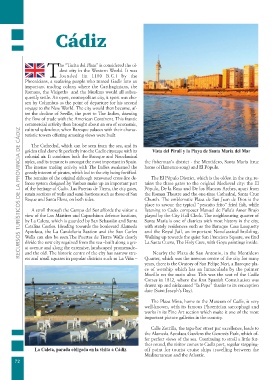
            golden tiled dome fit perfectly into the Cadiz cityscape with its  Vista del Pirulí y la Playa de Santa María del Mar
            colonial air. It combines both the Baroque and Neoclassical
            styles, and its treasure is amongst the most important in Spain.  the fisherman’s district - the Mentidero, Santa María (true
            The intense trading activity with The Indies awakened the  home of flamenco song) and El Pópulo.
            greedy interest of pirates, which led to the city being fortified.
            The remains of the original although renovated cross-fire de-  The El Pópulo District, which is the oldest in the city, re-
            fence system designed by Vauban make up an important part  tains the three gates to the original Medieval city: the El
            of the heritage of Cadiz. Las Puertas de Tierra, the city gates,  Pópulo, De la Rosa and De los Blancos Arches, apart from
            retain sections of walls and semi-bastions such as those of San  the Roman Theatre and the one-time Cathedral, Santa Cruz
            Roque and Santa Elena, on both sides.               Church. The emblematic Plaza de San Juan de Dios is the
                                                                place to savour the typical “pescaíto frito” fried fish, while
               A stroll through the Campo del Sur affords the visitor a  listening to Cadiz composer Manuel de Falla’s Amor Brujo
            view of the Los Mártires and Capuchinos defence bastions,  played by the City Hall Clock. The neighbouring quarter of
            by La Caleta, which is guarded by San Sebastián and Santa  Santa María is one of districts with most history in the city,
            Catalina Castles. Heading towards the boulevard Alameda  with stately residences such as the Baroque Casa Lasquetty
            Apodaca, the La Candelaria Bastion and the San Carlos  and the Royal Jail, an important Neoclassical building.
            Walls can also be seen.The Puertas de Tierra Walls clearly  Walking up towards the quiet San Francisco Square, we find
            divide the new city regained from the sea –built along a gre-  La Santa Cueva, The Holy Cave, with Goya paintings inside.
            at avenue and along the extensive, landscaped promenade–
            and the old. The historic centre of the city has narrow stre-  Nearby the Plaza de San Antonio, in the Mentidero
            ets and small squares in popular districts such as La Viña –  Quarter, which was the nervous centre of the city for many
                                                                years, there is the Oratory of San Felipe Neri, a Baroque pla-
                                                                ce of worship which has an Inmaculada by the painter
                                                                Murillo on the main altar. This was the seat of the Cadiz
                                                                Cortes in 1812, where the first Spanish Constitution was
                                                                drawn up and nicknamed “la Pepa” thanks to its conception
                                                                date (Saint Joseph’s Day).

                                                                   The Plaza Mina, home to the Museum of Cadiz, is very
                                                                well-known, with its famous Phoenician sarcophagi and
                                                                works in its Fine Art section which make it one of the most
                                                                important picture galleries in the country.

                                                                   Calle Zorrilla, the tapa-bar street par excellence, leads to
                                                                the Alameda Apodaca Gardens the Genovés Park, which of-
                                                                fer perfect views of the sea. Continuing to stroll a little fur-
                                                                ther round, the visitor comes to Cadiz port, regular stopping-
                La Caleta, parada obligada en la visita a Cádiz  off point for tourist cruise ships travelling between the
                                                                Mediterranean and the Atlantic.
       72

